
Level 2 asks for a high degree of caution, not a return to normal: your stopover counts under the advice, Gulf airspace can still close at short notice, and the level itself can change after you book.
Smartraveller lowered the UAE and Qatar to Level 2 on 8 October. Smartraveller's UAE advice was still current at 20 October 2026. That is welcome news if you are flying to Europe, the UK or Africa through Dubai, Abu Dhabi or Doha. It is not the all-clear.
One count shows why. Smartraveller's Middle East conflict page groups 14 countries by advice level: two at Level 2 (the UAE and Qatar), six at Level 3 and six at Level 4. Smartraveller tells the Level 3 group to "Avoid non-essential travel, including transit" and the Level 4 group to "Avoid all travel, including transit". The UAE and Qatar are the only two on that list where Smartraveller does not advise against changing planes. That is our count, from that page.
The list has moved since that page was last updated. Saudi Arabia appears there at Level 3. Its own page now says "do not travel", updated on 19 October and still current at 20 October. Reading the two pages together, our count is now five countries at Level 3 and seven at Level 4. The two Gulf hubs sit in the middle of that.
So Level 2 changes what Smartraveller asks of you. It does not change what can happen to your flight. This guide from Travel Times covers what that means for a stopover, from booking to boarding.
Is it safe to transit Dubai?
Source: Smartraveller
Smartraveller does not call Level 2 "safe", and neither should you when you plan. Level 2 is "Exercise a high degree of caution". For the UAE, the reason given is the threat of terrorism and the unpredictable security situation in the region. For Qatar it is the unpredictable security situation in the region.
Level 2 is not a "no risk" rating: Smartraveller says it means there are more or higher risks than in a large Australian city and that conditions can change with little warning.
The airport risk is spelt out on both pages. "UAE airspace may open or close at short notice", which affects Abu Dhabi and Dubai International. "Qatari airspace could close at short notice", which affects Hamad International in Doha.
The UAE page adds a harder line. Where there is a risk of armed conflict, you may be unable to leave if the security situation deteriorates. The levels themselves may change at short notice. Treat Level 2 as a reading on the day you check, not a fixed fact.
Does a stopover count as travelling there?
| Level | Name | What Smartraveller says about transit | Countries (as at page date) |
|---|---|---|---|
| Level 2 | "Exercise a high degree of caution" | "Monitor current events if you choose to travel to or transit through these locations... Be prepared to change your plans at short notice" | UAE and Qatar (lowered 8 Oct 2026) |
| Level 3 | "Reconsider your need to travel" | "Avoid non-essential travel, including transit" and "'Reconsider your need to travel' means 'reconsider your need to transit'" | Bahrain, Israel, Jordan, Kuwait and Oman (the conflict page as at 8 Oct 2026 also lists Saudi Arabia here) |
| Level 4 | "Do not travel" | "Avoid all travel, including transit" and "'Do not travel' means 'do not transit'" | Iran, Iraq, Lebanon, Palestine, Syria and Yemen, plus Saudi Arabia (updated 19 Oct 2026, current at 20 Oct 2026) |
Transit is not exempt from advice levels: Smartraveller says "'Reconsider your need to travel' means 'reconsider your need to transit'" and "'Do not travel' means 'do not transit'".
At Level 2, the conflict page asks people who transit the UAE or Qatar to "Monitor current events" and be prepared to change plans at short notice. The UAE page also says to check the latest travel advice for your destination and any transit locations. That means every stop on your ticket, not just the hub.
The hubs are also part of other people's exit plans. Smartraveller's Saudi Arabia advice suggests land routes for those leaving, including to aviation hubs in the UAE and Qatar.
If a hub you are booked through ever moves up to Level 3, the advice for that level is direct: "Schedule direct flights if possible" and avoid stopovers in high-risk airports. That is a reason to know your alternatives now, not a forecast.
What can go wrong at a Gulf hub?
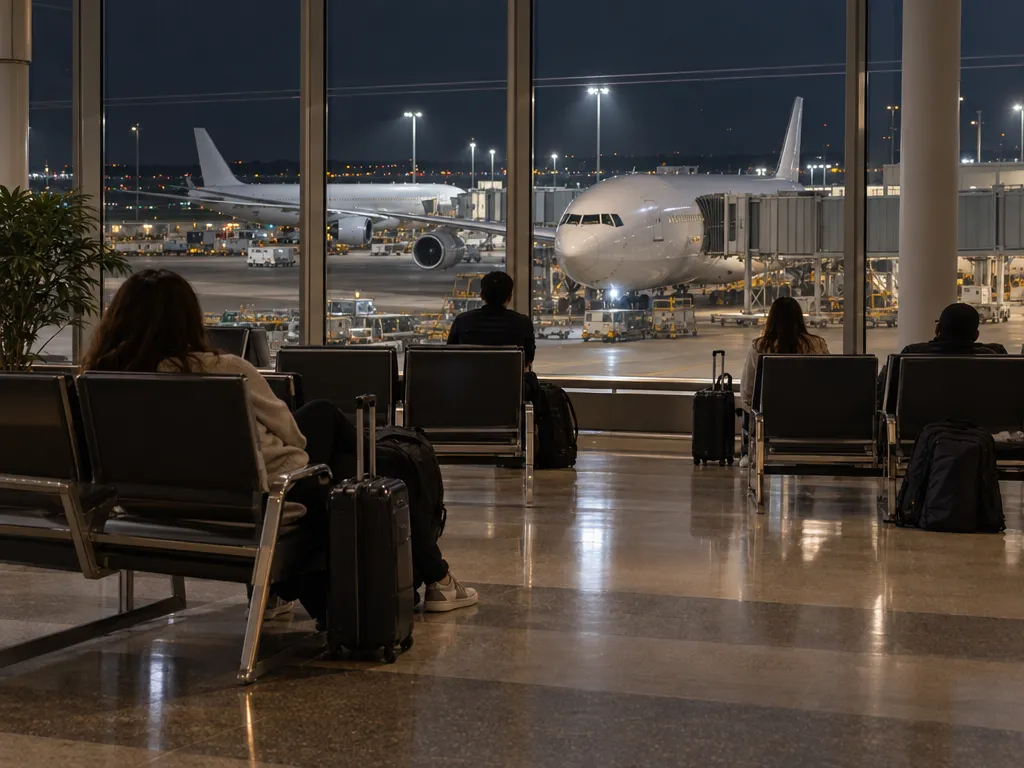
The UAE page lists the real risks in one line: "Airspace closures, flight delays, cancellations, and diversions can occur with little or no notice". A diversion can land you somewhere you never planned to be.
Fuel is the second risk, and it reaches beyond the region. The conflict page warns that "Airlines may also cancel or limit flights due to fuel shortages", which can affect travel anywhere.
None of this can be planned away, but most of it can be checked. Smartraveller says to check with your airline or travel provider before departure and to stay in contact with your airline or travel provider for changes.
Before you leave for the airport
How do I book a Gulf connection with fewer weak points?
Source: Smartraveller
How you book the trip matters as much as where you change planes. In a case study in the CHOICE guide on Smartraveller, a family missed an onward flight they had booked separately on another airline and were not provided with any accommodation. Their insurer's limited cover paid for accommodation and travel costs in London, because the initial delay caused the miss. The same guide says a policy covering missed connections may require "a reasonable time between connections".
Our view: in a region where delays come with little notice, a tight connection on two separate tickets is the weakest link in the trip. Give yourself a generous layover, and ask your insurer what it counts as reasonable before you lock in the times.
Then check the policy against the route. Smartraveller's travel insurance advice says to cover every country, and to "Include stopovers and transit points". It also says to check whether your policy covers you for cancellations if the advice level goes up after you've booked.
Timing matters too. The CHOICE guide explains that "unforeseen" means something not publicised in the media or on official government websites when you bought the policy. An event already known when you buy is not covered for its direct effect on your travel. Buying cover when you book, rather than the week you leave, keeps more of the trip inside that window.
Two exclusions are worth knowing. Military action such as war is commonly excluded, and for terrorism, most insurers cover medical expenses but very few cover cancellation expenses. Our earlier guide, Does travel insurance cover war?, walks through how each advice level affects cover.
If you plan to lean on a credit card policy, Smartraveller's warning is plain: "Don't assume it's activated". Smartraveller has also reported that several major Australian banks are reducing or removing complimentary credit card travel insurance, on existing cards as well as new ones. Read the PDS and ask the insurer directly. Policies vary too much to assume.
Questions to put to your insurer before you pay
Can I leave the airport on a stopover?
Passport and entry check before a stopover outside the terminal
UAE
Qatar
If you plan to step out into Dubai or Doha, your passport has to clear the entry rules, not just the airline's.
For the UAE, tourist visas are issued on arrival in Dubai and Abu Dhabi for Australian passport holders with more than six months' validity. Entry is refused if your passport shows "XX" for birthdate or gender, or shows only one name. Emergency passports are not accepted.
Coming back from Africa? The UAE restricts entry for travellers recently in Ebola-affected countries unless they have been outside them for more than 21 days, even if they travelled through other places on the way. If your African safari or trip to Zambia's waterfalls routes home through Dubai, check this against your dates before you plan a night in the city.
For Qatar, you may be asked to show proof of your accommodation for the whole stay on arrival at Hamad International. Smartraveller notes that entry and exit conditions can change at short notice. In public places, visitors are expected to cover shoulders and knees. If you hire a car, it is illegal to drive after drinking any amount of alcohol.
Which local laws apply even inside the terminal?
You do not have to pass immigration for UAE law to apply to you.
- Photos: you could be "fined, jailed or deported" for photos or videos of airports, transport infrastructure, government buildings or military conflict. That plane-spotting shot through the gate window is not worth it.
- Posting: it is illegal to "publish, share, or repost rumours or unverified information online". If airspace closes while you are on the ground, share only what you have confirmed.
- Drinking: "It's illegal to be drunk in public, including at airports across the UAE". Go easy on the long-haul drinks.
- Debts: with unresolved criminal charges, including unpaid debts, authorities may detain you on arrival, even if you're in transit.
What should I do if a warning sounds?
| Country | Alert system | If warned of an attack | Be ready |
|---|---|---|---|
| Qatar | National Alert System, a distinctive audible alert sent by cell broadcast to all mobile phones, even on silent, with no pre-registration or app, in Arabic and English, and a follow-up message when it is safe to resume normal activities. | "move to an enclosed hardened shelter. If these are not available, seek an inner room without windows." | "Ensure you have access to food, water and essential medicines." |
| UAE | "seek shelter indoors away from windows and external walls." |
Qatar's National Alert System sends a distinctive audible alert by cell broadcast to all mobile phones, even on silent. You do not need to register or download an app. Alerts come in Arabic and English, and a follow-up message tells you when it is safe to resume normal activities.
If you are warned of an imminent attack in Qatar, Smartraveller says to "move to an enclosed hardened shelter", or an inner room without windows if none is available. The UAE wording differs slightly: "seek shelter indoors away from windows and external walls". In a terminal, that means moving away from the glass.
Qatar's advice also says to "Ensure you have access to food, water and essential medicines". For a transit passenger, keeping essential medicines in your carry-on is a sensible way to do that.
What if my flight is cancelled?
Source: Smartraveller
Start with your airline or travel provider, and stay in contact with them for changes and updates.
Insurance usually comes second, and not straight away. The CHOICE guide says transport delay cover usually starts after about six hours, sometimes 12. Insurers also "often exclude cover for rescheduling caused by the transport provider". Keep boarding passes, receipts and the airline's messages, and read your PDS for exactly what the policy says.
If the situation turns serious, the consular emergency line is +61 2 6261 3305 from overseas, or 1300 555 135 from Australia. Save both numbers in your phone before you board.
Your Gulf stopover at a glance
Source: Smartraveller
Six figures carry most of this guide: the two Level 2 ratings, the six-month passport rule, the 21-day Ebola rule, the six to 12 hour delay threshold and the consular numbers. All of them can change, so treat the panel as a checklist to confirm, not a guarantee.
Planning a trip through the Gulf
Check the live UAE, Qatar and Middle East conflict pages the week you book, and again the day you fly. Talk to your airline or travel agent about alternative routes before you need one.
If you are weighing a Dubai or Doha connection for a trip to Europe, the UK or one of the destinations we write about in Africa and Australia, send Travel Times your question through the enquiry form below this article.
Sources
- https://www.smartraveller.gov.au/destinations/middle-east/united-arab-emirates
- https://www.smartraveller.gov.au/destinations/middle-east/qatar
- https://www.smartraveller.gov.au/destinations/middle-east/saudi-arabia
- https://www.smartraveller.gov.au/news-and-updates/travel-and-security-impacts-conflict-middle-east
- https://www.smartraveller.gov.au/advice-explained
- https://www.smartraveller.gov.au/travel-essentials/travel-insurance
- https://www.smartraveller.gov.au/choice-travel-insurance-buying-guide/what-are-you-covered-for
- https://www.smartraveller.gov.au/news-and-updates/credit-card-travel-insurance-changing
- Pictures in this guide are illustrations, not photos of our jobs.